Why this topic matters to me now
As soon as “bot detect” and “Chrome for research” meet in one paragraph, part of the audience expects a war. Who beat whom. Whose antifraud is “weaker”. Which build “doesn’t get caught”. I have seen those feeds. They click well and teach poorly.
I need another genre: a diary of method. How I think about browser and network layers. Where I am wrong. Which open tools help keep a clear head. Where the red line sits for what can be published.
If the series slides into a “site → how to pass” table, I lose my own charter — even if the table is technically flashy. Flash without ethics is especially toxic here: it disguises itself as “just engineering”.
Short: I choose the genre in advance, before emotion chooses it for me.
War as a genre and why it breaks the mind
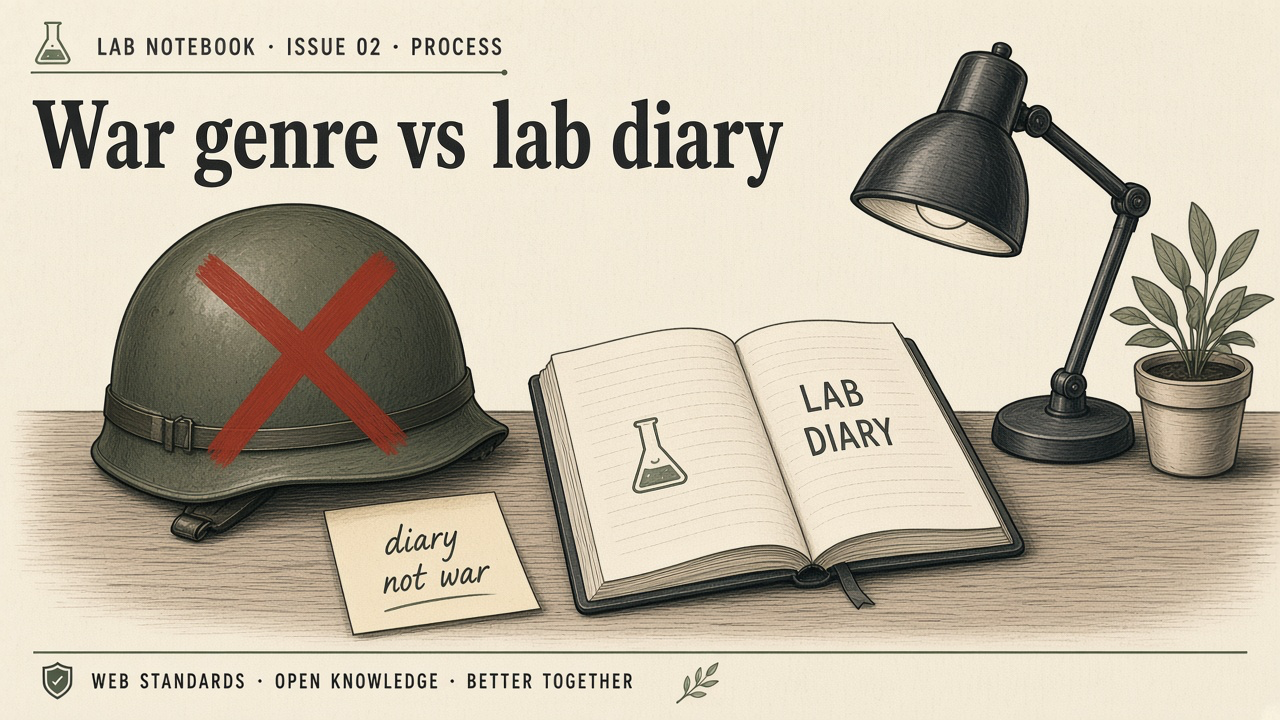
The war genre promises clarity. There is an enemy. There is a win. There is a score. In antifraud that clarity almost never exists — there is cost of error, everyday noise, uncertainty, people on VPN and in incognito.
The war genre pushes two bad roles.
First role — “hunter”. Then every odd signal wants to be called prey. False positives start to look like an acceptable sacrifice “for safety”.
Second role — “invisible one”. Then every red pixel on a public checker feels like a personal insult. The goal shifts from understanding layers to collecting green checkmarks.
Both roles hurt the lab. The lab needs a third role: a researcher who is glad when their own hypothesis dies.
Public frame
Public tools are useful precisely as textbooks, not as diplomas of invisibility.
The Browser API / Platform Consistency Detector page on x-bot.tech shows the language of contradictions: API capabilities versus claimed version, engine signs, cross-context mismatches, a summed “risk” of inconsistencies. Importantly, honest wording of such tools stresses the limit: client JS classifies an API surface. It does not issue a “human” certificate and does not prove a physical OS. Consistent spoof without leaks can stay indistinguishable — and you must be able to say that out loud if you claim adulthood.
The neighboring Chrome API + OS Detector branch adds another teaching accent: an OS portrait from many surface signals, without blind faith in the User-Agent OS token. That is also not “final truth”. It is a school of humility.
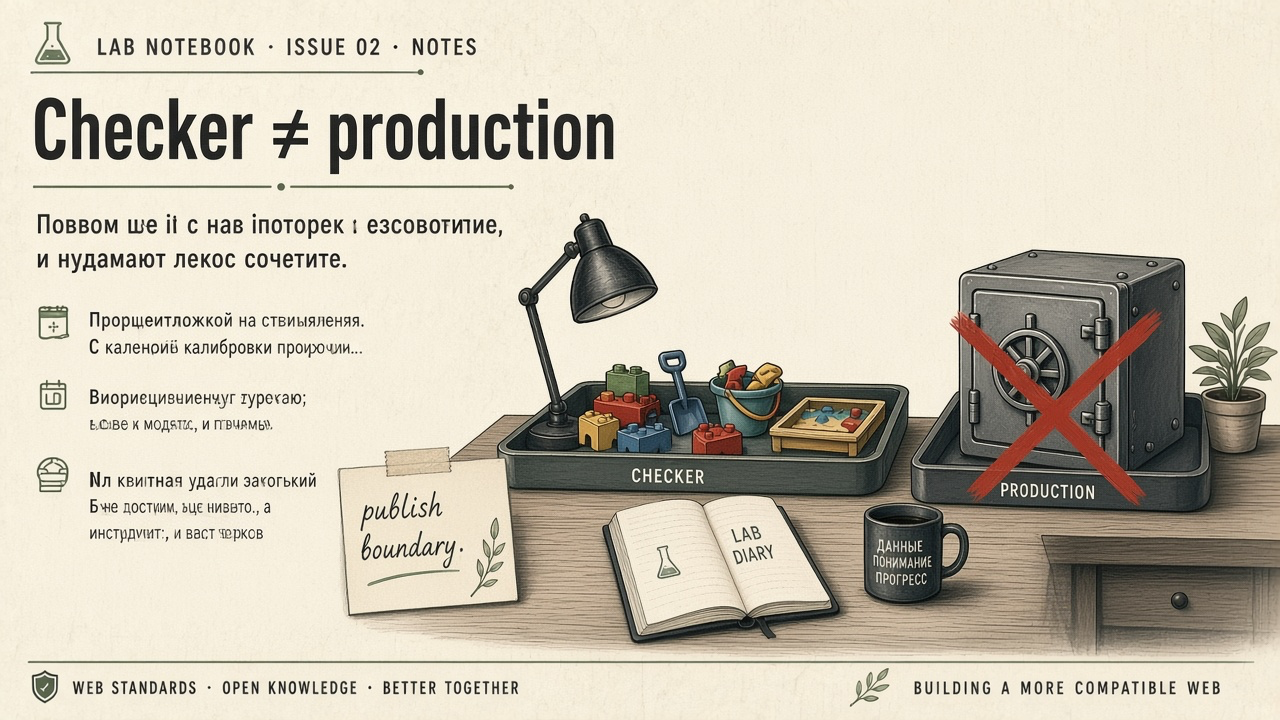
The detect.expert blog separately fixes an unpleasant but useful thought: a green public checker is not equal to production antifraud. Production looks longer, into other layers, with a different cost of error. Confusing those worlds is a favorite mistake of both those who “defend” and those who “bypass”, in internet comments.
Chrome documentation on privacy and Client Hints reminds us: even “official” hints can be reduced. If the browser itself cuts a claim for privacy, a naive detector that screams at truncatedness is fighting a normal user.
I read such sources as an alphabet. An alphabet is needed. A novel is not written automatically from an alphabet.
Checker and production: different classes of task
A checker answers fast and often generously marks “ok”. It is good for checking whether I forgot basic surface literacy: browser claims, simple APIs, obvious mismatches. It is a smoke test of thinking, not a verdict on the world.
A production contour is another density of tasks. Time, session, behavior, network as context, the cost of a false positive on a living person appear there. In this series I do not dissect other people’s production systems as a guide. But I must admit the class difference: otherwise the diary lies in tone.
In the lab it sounds like this: “today I tested a hypothesis of claim–measurement consistency”. Not: “today I beat brand Y”. The second phrase feeds ego and poisons method.
Another difference: a checker is almost always about “now on this page”. Production is more often about “visit history and risk on a horizon”. Whoever measures war with a checker is measuring a novel with a ruler.
What I observe in the lab, in general words
Audience requests
People ask for “specifics”. Sometimes that means open links and clear definitions — and that is good. Sometimes it means a step-by-step bypass — and then my answer is short: no. The series genre is not about that.
Useful specificity: “here are release notes, here is what Client Hints are, here is why VPN is context”. Harmful specificity: “here is how to pass this antibot tonight”.
My own genre slips
I myself sometimes slide into war language. “Caught”. “Bypassed”. “Doesn’t get caught”. Convenient verbs. They fit poorly with uncertainty and with respect for a living user.
When I notice war language in a draft, I rewrite the phrase into lab language. “Found contradiction A vs B”. “Hypothesis did not survive the baseline”. “This looks like everyday noise”. Duller. More honest.
A green checker as a status trap
A green screen calms. Calm sells itself as competence. Inside there may live layer inconsistency the checker simply does not ask about. So in the diary green is a reason to refine the question, not to close the topic.
Map of publication boundaries
I keep a simple checklist in plain sight.
Allowed: explain layers (claim / measurement / behavior / network as context); link to open documents and open teaching detectors; describe my own thinking mistakes; talk about false positives on everyday use.
Not allowed: step-by-step bypasses of specific systems; internal thresholds and production signal catalogs; recipes for fitting a specific antifraud; malware and “how to build a farm”.
Gray zone I cut toward “not allowed”: too detailed a breakdown of someone else’s production contour “right now”, even if facts are partly public. The cost of someone else’s error and abuse does not entertain me.
What this changes in detect and in the build
In detect I separate the educational layer from the operational. Educational can be explained publicly: layers, contradictions, why VPN ≠ bot, why privacy ≠ automation, why one hash is fragile. Operational stays inside: thresholds, internal signals, what turns literacy into a concrete contour.
Confusing those layers hurts the product (too much noise in the head) and the reader (a false sense they read a war manual).
In the build I reject the metric “green checkers everywhere = success”. A checker can be green with an internally inconsistent history. It can also be red on honest everyday noise. For a research browser I ask something else: what did I control? what did I change? which hypothesis died?
The link to the first text is direct. Two mirrors without a diary genre become two trenches. With the genre they stay a lab.
How I answer awkward requests
“Write how to pass X”. — No. I can explain why User-Agent is a claim, and where to read about Client Hints.
“Give internal thresholds”. — No. I can explain why soft everyday noise should not automatically become a sentence.
“Make a stealth guide”. — No. I can explain how a research Chromium differs from an invisibility cloak — and why a promise of invisibility is a red flag for me as an author.
Refusal is also content of the series. Without refusals the charter is decoration.
What I will not say and why
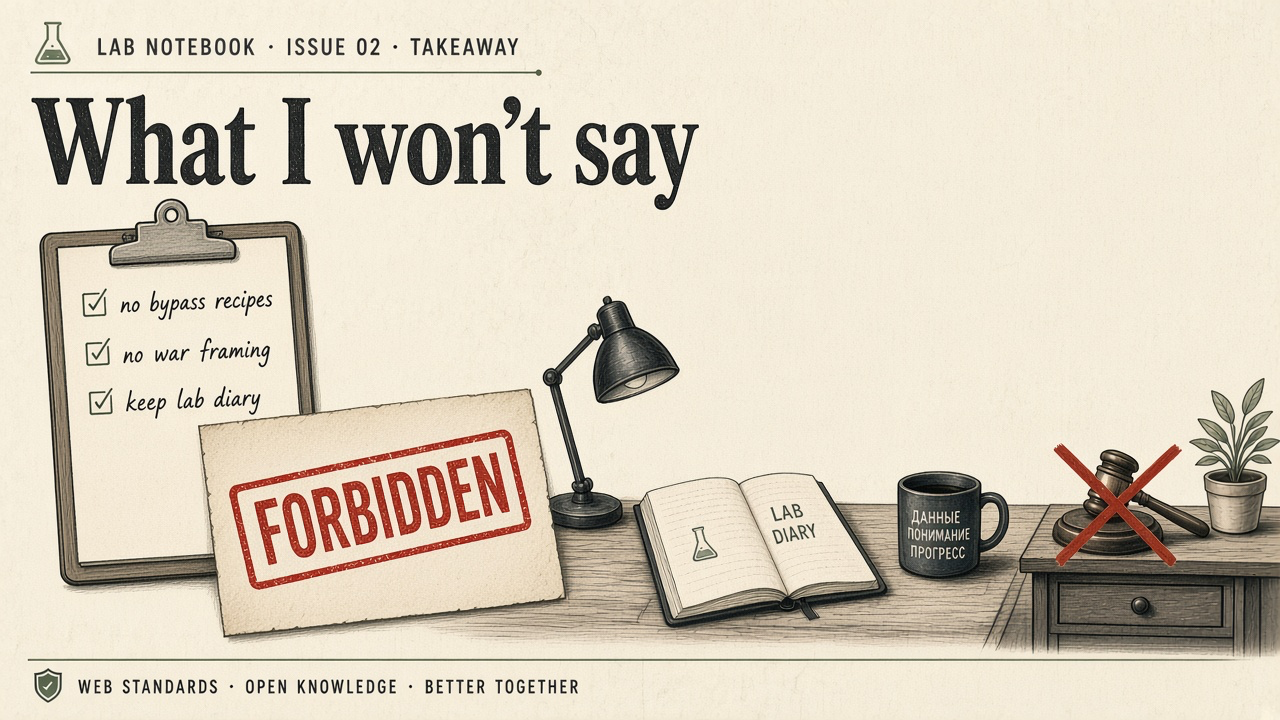
There will be no guides for specific antibots. No “update this piece and you will pass”. No step-by-step bypasses and “how to bypass X tonight” breakdowns.
There will also be no reverse toxic genre: “here is the exact recipe to guarantee killing any custom browser” for hype. The series is about thinking and boundaries, not weapons in both directions.
If a reader asks specifically for the forbidden — that is not “we under-explained”. That is a conscious refusal.
Short takeaway
I write a lab diary, not a chronicle of product wars. A public checker teaches letters. Production is another genre with another cost of error. My series stays in the genre of method: open sources, honest limits, zero recipes for harm.
The next text locks the lab language: profile consistency instead of the cult of one big hash.