Why this topic matters to me now
Open checkers are the best textbook for the surface alphabet. I read someone else’s public detector “as a textbook”: what comes from release notes, what risk means via contradictions, where authors honestly say what the tool does not prove.
The goal is to take a way of thinking — not drag someone else’s UI and heuristics into production.
Public frame (links)
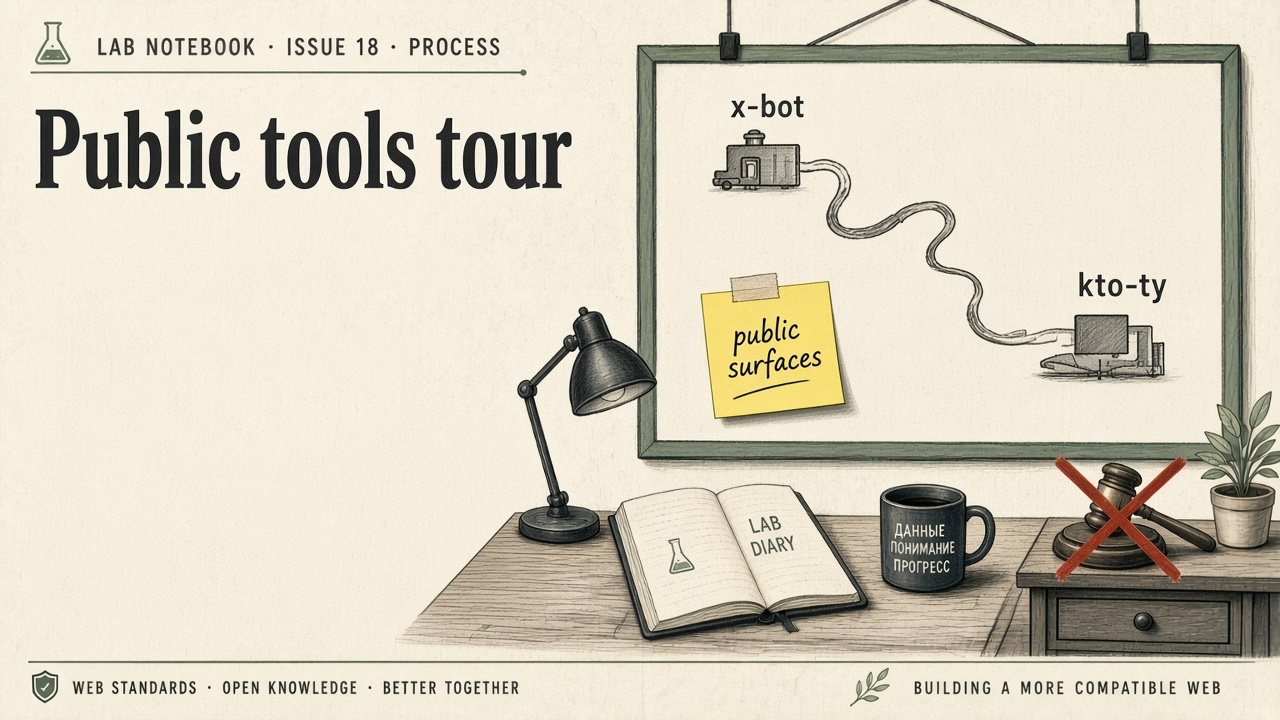
- x-bot version1 — API / platform consistency
- x-bot version — API + OS detector
- kto-ty — mashup showcase of other people’s checks
What I observe in the lab, in plain words
version1 vs version
Different accents in one family of ideas: floor/consistency and surface/OS portrait. Useful as a map of questions. Not as a sacred canon of truth.
Why kto-ty is a glue layer
It is a UI that gathers other people’s signals in one window. Useful for seeing how people read checkers. It is not a new truth engine. When authors are careful and mark the “not human/bot” boundaries, that is good tone — I want the same tone in the diary.
What I adopt / what I do not copy
I adopt: the language of contradictions, cross-realm thinking, refusing the cult of one hash, the habit of citing the public feature calendar. I do not copy: someone else’s UI as prod, someone else’s heuristics as combat weights, any understood “holes” as an bypass guide.
What this changes in detect and/or the build (no specifics)
A checker stays a literacy smoke test. The lab does not confuse a green pixel scan with trust. The build does not celebrate “passed x-bot” as the end of the experiment.
What I will not say, and why
No teardown of “how to bypass x-bot” and no moving their internals into my combat contour through public text.
Short first-person takeaway
Open tools are a textbook. A textbook is not a diploma and not a weapon. I read them to ask better questions — not to lie better.